According to the 2022 Time Use Survey from Germany’s Federal Statistical Office, the average sleep duration in Germany is about 8 hours and 37 minutes per day. For many adults, that number sounds surprisingly high—especially for anyone balancing work, children, training, and unpredictable schedules.
Key takeaways
1. Overall figure: about 8 hours and 37 minutes of sleep per day.
2. Main context: an average is not a recommendation. For most adults, 7 to 9 hours of sleep is often used as a general reference range.
3. Why the number may seem high: it is measured “per day,” not only as typical nighttime sleep on workdays.
The key point is that this figure does not simply mean “sleep per night.” It comes from a time use survey and refers to sleep duration per day. That can include nighttime sleep, going to bed early, sleeping in, naps, and differences between age groups.
For your own sleep, the average is only a starting point. What matters is whether your sleep duration fits your daytime energy, mood, concentration, training recovery, and overall health situation. Below, you’ll find the German benchmark, the logic behind the measurement, and a practical 14-day routine to help you assess your sleep realistically rather than dogmatically.
Why Sleep Duration Is More Than a Statistic
Sleep is a central part of recovery. It affects not only tiredness, but also training adaptation, appetite regulation, emotional stability, focus, and resilience over several days. For physically active people, too little sleep—or highly inconsistent sleep—can make performance harder to interpret: Was the training too hard, was stress too high, or was recovery too short?
Beyond day-to-day performance, research in college athletes suggests that insufficient sleep is associated with a higher in-season injury risk, even after accounting for.
Our overview of sleep and recovery looks at exactly this connection: sleep is not an isolated health metric, but a recovery signal. The same sleep duration can affect two people differently depending on how regular their rhythm is, how fragmented their sleep was, and what kind of load they had the day before.
With benchmarks, the better question is not: “Do I sleep like the average person?” It is: “What exactly is being measured, who am I being compared with, and what decision can I actually draw from it?”
Quick Answer
Based on the provided information from the Federal Statistical Office’s Time Use Survey, average sleep duration in Germany in 2022 was 8:37 hours per day. Ten years earlier, it was reportedly eight minutes lower. The survey includes people aged 10 and older, which means it combines children, teenagers, working-age adults, and older adults.

- Overall figure: about 8 hours and 37 minutes of sleep per day.
- Main context: an average is not a recommendation. For most adults, 7 to 9 hours of sleep is often used as a general reference range.
- Why the number may seem high: it is measured “per day,” not only as typical nighttime sleep on workdays.
- For working-age adults: according to the provided Destatis age-group figures, average sleep duration is lower than among children, teenagers, and older adults.
- Practical interpretation: also look at sleep quality, regularity, daytime sleepiness, caffeine reliance, and recovery after training or stress.
If you want to do more than simply observe your sleep, you can track your sleep duration and sleep efficiency in the huuman app and focus on trends rather than.
What “Average Sleep Duration” Really Means
The most common misunderstanding comes from the term sleep duration. In everyday conversation, it usually means: “How long did I sleep last night?” In a time use survey, it means something closer to: Which parts of the day were assigned to sleep? That is a valid method, but it answers a different question.
- Sleep duration per day: a time-budget perspective. It can include nighttime sleep and additional sleep periods during the day.
- Time in bed: the period between lying down and getting up. This often overestimates actual sleep time if it takes a long time to fall asleep or if you are awake for longer periods during the night.
- Sleep time per night: closer to the everyday question, but often affected by memory, estimates, and differences between weekdays and weekends.
- Wearable sleep data: algorithmic estimates based on movement, heart rate, and similar signals. Useful for trends, but not the same as a sleep lab measurement.
That is why a Destatis figure of 8:37 and your wearable figure of 7:12 can both be plausible. They are not measuring the same thing. If you mix up the terms, you end up comparing methods rather than sleep.
Germany Benchmark by Age Group
The overview below summarizes the 2022 Destatis figures included in the briefing. It should be read as a population benchmark, not as a target for an individual person.
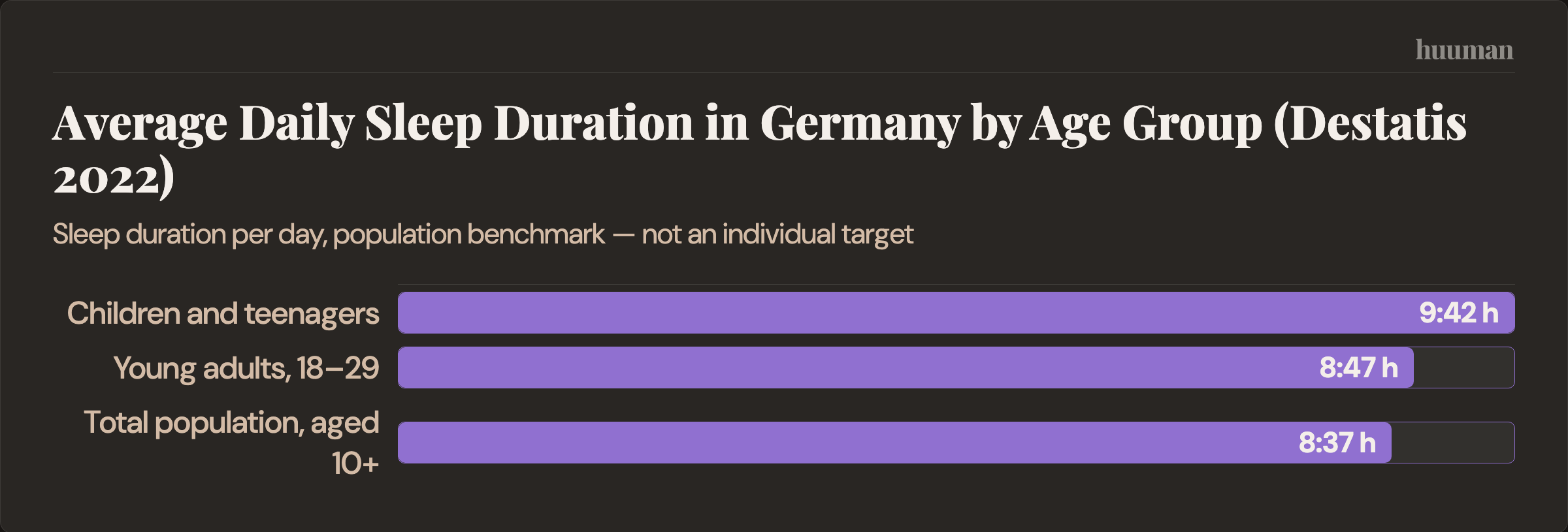
Table 1: Germany: Average sleep duration per day, overall and by age group, Destatis 2022
- Total population aged 10 and older: 8:37 hours. Time Use Survey, sleep duration per day.
- Children and teenagers: about 9:42 hours. Higher sleep needs and a different daily structure.
- Young adults, 18 to 29 years: about 8:47 hours. Average across different education, university, and work models.
- Working-age adults, 30 to 64 years: about 8:20 hours. Lower figure, plausibly influenced by work, caregiving, commuting, and fixed responsibilities.
- Older adults, 65 years and older: about 8:46 hours. More available time during the day does not automatically mean better sleep quality.
For the question “How much do adults in Germany sleep on average?”, the 30-to-64 age group is especially relevant. At about 8:20 per day, it is below the overall figure, but still higher than what many people would report as pure nighttime sleep on weekdays. This is exactly where the measurement method matters.
If you are looking for sleep figures for children, separate age groups are more useful than a national average across all ages. Very young children need their own benchmarks, such as those discussed in sleep duration at age 3 or baby sleep duration.
Life Situation: Why Averages Differ
Age explains only part of the variation. Life circumstances often affect sleep more directly: children in the household, shift work, caregiving, long commutes, late training sessions, social commitments, and chronic stress all influence when sleep is possible and how stable it remains.
According to the provided Destatis information, couples with children sleep 19 minutes less on average than comparable groups without that burden. This is not a judgment about individual sleep behavior; it points to structural constraints. Parents of young children often have not only less sleep, but also more fragmented sleep. For recovery, that can matter just as much as total duration.
The weekday effect also matters. Many people sleep less during the week and longer on weekends. If a specific source does not provide separate values for weekdays and weekends, you should not infer exact minute differences. The concept still matters, though: highly variable sleep times can feel like social jet lag, a conflict between your biological rhythm and your social calendar.
Chronotype plays into this as well. Morning types and evening types differ in when they naturally feel tired and alert. A late chronotype with an early work start may be fighting their natural rhythm even if they spend enough time in bed. An early chronotype may fall asleep easily in the evening but wake very early. Sleep duration alone misses this dynamic.
Method Table: Why 8:37 Is Not the Same as Your Wearable Number
If you want to compare sleep data, you first need to understand how it was measured. This method table is often more useful than another average figure.
Table 2: What does 8:37 mean?
- Measurement approach: sleep duration per day, time use
What is measured: sleep time reported within the daily time budget.
Typical limitation: depends on self-reporting, daily structure, and how sleep periods are defined.
Useful for: population comparisons, age groups, and long-term social trends. - Measurement approach: sleep per night, weekday self-report
What is measured: usually estimated nighttime sleep on workdays or school days.
Typical limitation: memory, rounding, confusion with time in bed, and often no weekend data.
Useful for: everyday context for workers, shift workers, parents, and students. - Measurement approach: wearable sleep data
What is measured: algorithmic estimates based on movement, heart rate, breathing patterns, or activity patterns.
Typical limitation: sleep stages can vary, quiet wakefulness may be interpreted as sleep, and models differ between devices.
Useful for: trends across several weeks, regularity, wake patterns, and combinations with resting heart rate or HRV. - Measurement approach: polysomnography in a sleep lab
What is measured: physiological sleep parameters under controlled conditions.
Typical limitation: unfamiliar environment, and a single night does not fully represent everyday life.
Useful for: clinical assessment of specific sleep problems by qualified professionals.
With wearables, it is especially important not to overinterpret every sleep-stage value. If you want to understand individual metrics, see the explanations of what sleep efficiency means, what counts as good sleep efficiency, what a 100 sleep score means, and deep sleep duration. The greatest value comes from comparing trends across days and weeks, not judging one isolated night.
How Much Sleep Do Adults Need?
For most adults, 7 to 9 hours is often cited as a general reference range. Because the external sources provided here did not include a linked guideline source, this range should be understood as a common orientation point, not.
Mini-overview: commonly cited reference ranges for sleep need
- Children and teenagers: usually need more sleep than adults, with substantial differences by age.
- Adults: commonly cited reference range of 7 to 9 hours.
- Older adults: sleep need and sleep structure can change. Earlier waking, more wake periods, and naps can occur, and total duration alone does not explain everything.
The better individual question is: Does your amount of sleep support how you function during the day? Signs of too little or non-restorative sleep can include pronounced daytime sleepiness, reduced concentration, unusually high caffeine reliance, irritability, declining training quality, or frequently falling asleep in quiet situations. Conversely, an occasional night of 6.5 hours is not automatically a problem if it is rare and you recover well.
Evidence and Limitations
For the Germany-specific question, the strongest source here is the Destatis Time Use Survey, because it provides a population-level view of sleep duration per day. Its strength is comparison across groups and years. Its limitation is that it is not the same as objective sleep physiology or your specific recovery after a workweek.
Health monitoring, for example by public institutions such as the RKI, can place sleep in the context of age, health, and symptoms. Health insurance studies often provide self-reports that are close to everyday life, such as sleep during the week, stress, or subjective sleep problems. Such studies can be practically useful, but methodologically they are not automatically comparable with Destatis time-budget data.
Polysomnography and clinical diagnostics are more precise for sleep stages and certain sleep disorders, but they do not answer the population question “How long does Germany sleep on average?” Wearables fill a gap in everyday life because they provide continuous trends. Their strength lies in regularity and patterns, not in perfect accuracy for individual sleep stages.
Because no external source links were provided for direct verification, this article does not include formal references. The Destatis figures mentioned come from the supplied content brief. For scientific or editorial reuse, the original source should be checked directly.
Strategies to Discuss With a Professional
The goal is not to reach 8:37. The goal is to align your individual sleep need with your real life. Many programs use short experiments over 14 days because individual nights can be heavily affected by stress, alcohol, travel, illness, late meals, or training.
- Stabilize your wake-up time: A similar wake-up time on most days can anchor your sleep rhythm better than constantly changing bedtimes. For busy professionals, this is often the most effective lever against social jet lag.
- Use light deliberately: Bright light in the morning and dimmer light in the evening can help stabilize the day-night rhythm. This is especially relevant with heavy screen use or dark winter mornings.
- Test caffeine realistically: Instead of relying on blanket rules, a time-limited test can be useful: does falling asleep, waking during the night, or daytime sleepiness change when you stop caffeine earlier?
- Review training timing: Late, intense sessions can disrupt falling asleep or nighttime recovery for some people. Active people should interpret sleep data together with training load, intensity, and perceived recovery. If fatigue is building, a planned lighter training block may also be relevant, as described in how long to deload.
- Support parents instead of “optimizing” them: With young children, fragmented sleep is often not a matter of willpower. Short rest windows, realistic expectations, and sharing responsibilities may matter more than perfect sleep hygiene.
- Look more carefully after 60: Earlier waking or changes in sleep structure can occur. What matters is whether daytime sleepiness, mood, performance, or everyday safety are affected.
How to Measure and Interpret Progress
A simple sleep-fit check takes about two minutes and is often more useful than an isolated average. Ask yourself in the morning: roughly how long did it take me to fall asleep? Were there longer wake periods? How sleepy am I during the day? Are performance or mood dropping? Do I need caffeine just to function normally?

For 14 days, a compact three-metric tracking approach is enough. First: how consistent is your wake-up time? Second: how recovered do you feel on a scale from 1 to 10? Third: how much wake time after falling asleep did you have, if known, or how many conscious wake periods do you remember? A concrete entry might look like this: wake-up 06:45, recovery 7 out of 10, two short wake periods, normal training possible.
Wearable data can complement this self-observation. Resting heart rate, heart rate during sleep, and HRV can provide clues about load or recovery, but they are not a diagnosis. If you use these values, read them as trends: does an elevated resting heart rate line up with late training, alcohol, feeling unwell, or poor sleep? For context, see resting heart rate in athletes, HRV values, heart rate during sleep, and HRV by age.
For a more structured next step, your huuman Coach can adapt weekly plans to your sleep, training, stress, and available time instead of steering.
Signal and Noise in Sleep Duration
- Signal: Your wake-up time becomes more consistent over several days and your daytime energy improves. Watch whether this also holds on workdays.
- Signal: You fall asleep more easily across several nights without spending longer in bed. Check which change was consistent beforehand.
- Signal: Your need for caffeine in the morning decreases. Compare that with sleep duration, wake periods, and work stress.
- Signal: Training performance and mood stay more stable under similar load. Consider training intensity and recovery together.
- Noise: One bad night after acute stress. Do not treat it as your new normal; wait for a pattern.
- Noise: Highly variable wearable sleep-stage data. Use sleep stages as context, not as the sole basis for decisions.
- Noise: Treating eight hours as a fixed target without looking at sleepiness. Check whether you actually function better with slightly less or slightly more.
- Noise: Using the weekend as your only repair strategy. Notice whether sleeping in for a long time makes Monday harder.
- Noise: Comparing yourself with the German average without considering age and life context. Your own 14-day trends are usually more useful.
Common questions
What is the current average sleep duration in Germany?
According to the provided Destatis figures for 2022, average sleep duration in Germany is about 8 hours and 37 minutes per day. The figure applies to the population aged 10 and older included in the survey and is a time-use value, not a personal ideal.
Is the Destatis figure per day or per night?
It should be understood as sleep duration per day. That is exactly why it can seem higher than typical reports of nighttime sleep on workdays. When comparing your own sleep, clarify whether you are looking at time in bed, actual sleep time, nighttime sleep, or total sleep across the day.
How much do adults in Germany sleep on average?
For working-age adults from 30 to 64, the briefing cites about 8 hours and 20 minutes per day. Young adults are reported at about 8:47, and older adults at about 8:46. These are group averages, not recommendations.
Why do people with children in the household often sleep less?
Children affect sleep not only through earlier wake-up times, but also through interruptions, mental load, and less flexible recovery windows. According to the provided Destatis information, couples with children sleep 19 minutes less on average. For parents, sleep quality and daytime recovery are therefore often just as important as duration alone.
Is 6.5 hours of sleep enough?
For an occasional single night, it may be unproblematic. Regularly sleeping 6.5 hours may be below the commonly cited reference range for many adults. Patterns matter most: daytime sleepiness, concentration, mood, caffeine use, training adaptation, and health complaints.
Is it a problem to regularly sleep 9 to 10 hours?
More sleep is not automatically better or worse. Regularly long sleep times can be harmless, for example during high load or because of individual need, but they can also be a reason to look more closely at sleep quality, mood, medication, infections, or other factors. If strong tiredness persists despite long sleep duration, professional assessment is advisable.
What can I do if I sleep enough but do not feel recovered?
First check whether “enough” means time in bed or actual sleep. Then observe wake periods, regularity, alcohol, late meals, stress, training timing, and how recovered you feel in the morning. If you have severe daytime sleepiness, snoring with possible breathing pauses, a tendency to fall asleep while driving, depressive symptoms, or marked restlessness in the legs, this should be assessed by a professional.
Average sleep duration in Germany is a useful benchmark, but not a target. Better decisions come from combining the measurement method, your life situation, and how you function during the day: How stable is your rhythm, how recovered do you feel, and how does your body respond to stress and training?
More health topics to explore
- Sleep & Recovery – Overview
- Signs You Need a Deload Week
- How Much Sleep Do Babies Need? Age Guide + Practical Tips for Parents
- What a 100 Sleep Score Really Means: Oura, Garmin, Fitbit, Eight Sleep
References
- RKI — Themenblatt: Schlaf
- AASM/SRS Konsensus-Empfehlungen zur Schlafdauer für Erwachsene
- Watson A et al. — Decreased Sleep Is an Independent Predictor of In-Season Injury in Male... (2020)
- Durmer et al. — Neurocognitive consequences of sleep deprivation (2005)
- Silva CM et al. — Chronotype, social jetlag and sleep debt are associated with dietary intake... (2016)
- Zisapel et al. — Circadian rhythm sleep disorders: pathophysiology and potential approaches to management. (2001)
About this article · Written by the huuman Team. Our content is based on peer-reviewed research and clinical guidelines. We follow editorial standards grounded in scientific evidence.
This article is for educational purposes only and does not constitute medical advice. Health and training decisions should be discussed with qualified professionals.