Human walking speed is often searched for as a single number, but in real life it depends heavily on context. A relaxed stroll, a commute, brisk walking, and hiking all involve different speeds, different levels of effort, and different meanings.
Key takeaways
1. Easy: often around 3 to 4 km/h, suitable for strolls and conversation.
2. Average: roughly 4.5 to 5.5 km/h, typical for purposeful walking without rushing.
3. Brisk: often around 5 to 6 km/h, noticeably effortful but usually still controlled.
Below, you’ll find typical ranges in km/h, m/s, and min/km, simple conversions, practical walking times for 1 km, and a standardized 10-minute self-test. The goal is to help you put your own walking pace into context without reading too much into one isolated number.
Individual differences are normal. Age, height, stride length, fitness, sleep, stress, surface, incline, footwear, and load can all meaningfully change walking speed.
Why walking speed is more than an everyday number
Walking speed is a practical signal of functional capacity. It brings together endurance, muscular stamina, mobility, coordination, and how you feel on a given day in a movement you probably do regularly anyway. That is why, when measured consistently and interpreted carefully, it can be more useful for many people than an isolated fitness metric.
Within heart and endurance training, walking pace sits between everyday activity and structured exercise. It is less maximal than a VO2max test, but often easier to repeat. If you also pay attention to heart rate, basics such as beats per minute and cardiovascular load can help you understand the effort more clearly.
Recovery matters too. After poor sleep, heavy work stress, or unfamiliar training, many people first notice that normal walking feels harder or that their pace drops at the same perceived effort. That does not make walking speed a diagnosis, but it can make it a useful trend alongside sleep, resting heart rate, HRV, and subjective fatigue.
Quick answer
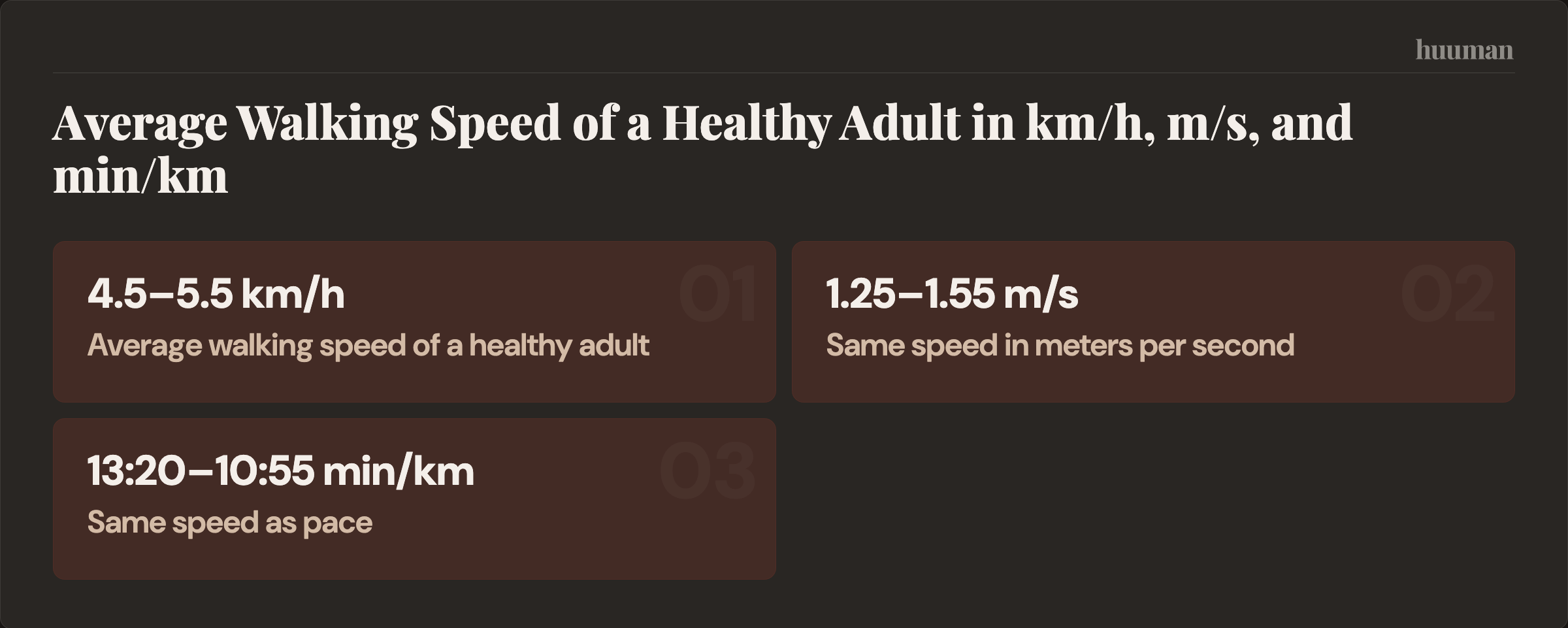
The average walking speed of a healthy adult is roughly 4.5 to 5.5 km/h. That is about 1.25 to 1.55 m/s, or a pace of around 13:20 to 10:55 min/km.
- Easy: often around 3 to 4 km/h, suitable for strolls and conversation.
- Average: roughly 4.5 to 5.5 km/h, typical for purposeful walking without rushing.
- Brisk: often around 5 to 6 km/h, noticeably effortful but usually still controlled.
- Power walking: can be faster, often around 6.5 to 8 km/h, depending on technique, fitness, and body type.
The best comparison is not an internet average, but your own standardized measurement: 10 minutes on a flat, uninterrupted route, with distance, RPE, and the talk test recorded.
If you want to track your self-test consistently, you can log your walking pace and RPE in the huuman app and see over several weeks whether pace, perceived effort, and recovery change.
What does walking speed actually mean?
Walking speed describes distance covered per unit of time. In everyday use, it is usually given in km/h. In research and clinical settings, it is often shown in m/s. In endurance training, it is commonly expressed as min/km, or pace. All three describe the same speed from different angles.
It is important to distinguish between habitual and brisk walking speed. Habitual walking speed is your self-selected normal pace, such as when commuting or walking without consciously training. Brisk walking speed is faster, but still controlled. Maximum walking speed means walking as fast as possible without breaking into a run. These three categories are not interchangeable.
For fitness and everyday life, habitual speed is often the more honest measure. It shows how you move when you are not testing yourself, performing, or especially motivated. For training and load management, brisk walking can provide more information because it places greater demands on the cardiovascular system, breathing, and muscular endurance.
Average walking speed by purpose
The overview below is a practical guide, not a normative table. The ranges overlap because body size, route, surface, weather, and the purpose of the walk all have a strong effect. A shorter person with a shorter stride may already be walking very briskly at 5.5 km/h, while the same speed may feel more moderate for a taller person.

Table 1: Walking speed by purpose
- Easy: about 3 to 4 km/h, about 0.83 to 1.11 m/s, about 20:00 to 15:00 min/km. Typical for strolls, recovery walks, and conversation without breath pressure.
- Average: about 4.5 to 5.5 km/h, about 1.25 to 1.53 m/s, about 13:20 to 10:55 min/km. Typical for purposeful everyday walking.
- Brisk: about 5 to 6 km/h, about 1.39 to 1.67 m/s, about 12:00 to 10:00 min/km. Typical for faster walking with noticeable but controlled breathing.
- Power walking: about 6.5 to 8 km/h, about 1.81 to 2.22 m/s, about 9:14 to 7:30 min/km. More technically demanding, usually with active arm swing and a high step rate.
In daily life, pace is often lower than it would be on a test route. Traffic lights, crossings, crowds, dogs, strollers, conversations, shopping bags, and short stops all pull average walking speed down. Hiking adds incline, surface, turns, footing, and backpack weight, so hiking pace is not directly comparable with city walking pace.
Conversion: km/h, m/s, and min/km
For most purposes, two formulas are enough. To calculate pace in minutes per kilometer, divide 60 by km/h. To calculate meters per second, divide km/h by 3.6. If you walk at 5 km/h, for example, you need 12 minutes for 1 km and move at about 1.39 m/s.
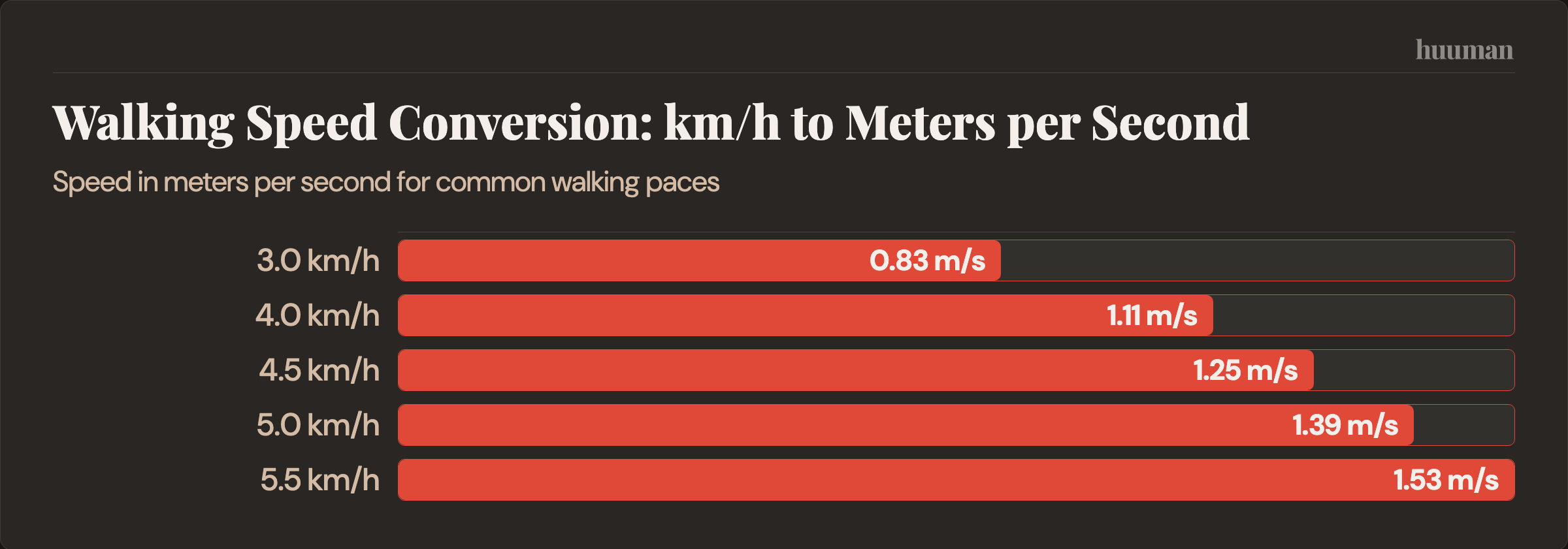
Table 2: Quick conversion for common walking speeds
- 3.0 km/h: 20:00 min/km, 0.83 m/s.
- 4.0 km/h: 15:00 min/km, 1.11 m/s.
- 4.5 km/h: 13:20 min/km, 1.25 m/s.
- 5.0 km/h: 12:00 min/km, 1.39 m/s.
- 5.5 km/h: 10:55 min/km, 1.53 m/s.
- 6.0 km/h: 10:00 min/km, 1.67 m/s.
- 6.5 km/h: 9:14 min/km, 1.81 m/s.
- 7.0 km/h: 8:34 min/km, 1.94 m/s.
- 8.0 km/h: 7:30 min/km, 2.22 m/s.
Table 3: Practical benchmarks for walking 1 km
- 3.0 km/h: 1 km takes about 20 minutes.
- 4.0 km/h: 1 km takes about 15 minutes.
- 4.5 km/h: 1 km takes about 13 minutes and 20 seconds.
- 5.0 km/h: 1 km takes about 12 minutes.
- 5.5 km/h: 1 km takes about 10 minutes and 55 seconds.
- 6.0 km/h: 1 km takes about 10 minutes.
- 6.5 km/h: 1 km takes about 9 minutes and 14 seconds.
- 7.0 km/h: 1 km takes about 8 minutes and 34 seconds.
A simple walking-time calculator does not require an app: time for a route equals distance divided by speed. For 2.5 km at 5 km/h, you need about 30 minutes. In the other direction, walking 1 km in 10 minutes equals a speed of 6 km/h.
What your walking pace really depends on
The biggest mistake is treating walking speed as a pure measure of willpower or fitness. It comes from several components. Height and stride length influence how much distance you cover with each step. Step rate determines how often you repeat that distance per minute. Together, they produce walking speed.
Fitness and muscular endurance determine how long you can sustain a brisk pace. Aerobic capacity, which you can also put into context with concepts such as a VO2max table, mainly affects breathing and the ability to stay steady at higher speeds. Muscular endurance in the calves, glutes, thighs, and trunk helps you maintain posture and push-off.
Mobility is the underestimated factor. If the ankle or hip has limited range of motion, the body may create speed through shorter, more hurried steps or more upper-body movement. That is not automatically a problem, but it can become inefficient. Posture, active arm swing, and a calm rhythm are often more important than deliberately lengthening your stride.
External factors can shift the number substantially. Incline, cobblestones, soft ground, wind, heat, cold, shoes, a backpack, stop-and-go movement, and crowds can all change walking speed without any change in fitness. That is why a single GPS recording from daily life is rarely a clean benchmark.
How you feel on the day also matters. Poor sleep, high mental load, unusual meals, dehydration, or muscle soreness can make the same pace feel harder. If you want to include sleep and recovery in the picture, context such as average sleep duration, HRV values, resting heart rate in athletes, and cardio recovery can help, without turning one number.
Self-test: measure your walking speed in 10 minutes
A good self-test does not need to be complicated. It needs to be repeatable. For most people, a 10-minute test on a flat route is more useful than a very short all-out attempt because it captures everyday pace, perceived effort, and rhythm more reliably.
10-minute walking-speed test card
- Choose your route: flat, safe, with as few traffic lights, crossings, and steep sections as possible.
- Warm up: walk easily for 3 to 5 minutes without forcing test pace yet.
- Start the test: walk continuously for 10 minutes, briskly but without running. Keep the pace controlled.
- Record distance: use smartphone GPS, a sports watch, or a known route. GPS is practical outdoors, but can be inaccurate in urban canyons and over short distances.
- Record effort: note RPE from 1 to 10 and add the talk test: full sentences possible, short sentences possible, or speaking barely possible.
- Record context: briefly note sleep, stress, weather, shoes, load, and surface.
- Calculate speed: distance in kilometers multiplied by 6 gives km/h, because 10 minutes is one-sixth of an hour.
Example: You walk 0.85 km in 10 minutes. 0.85 multiplied by 6 equals 5.1 km/h. If that feels like RPE 5 out of 10 and you can still speak in full sentences, it says something different than 5.1 km/h at RPE 8 with clear breathlessness.
The 6-minute walk test is widely used as a concept in clinical and rehabilitation settings, but there it is performed and interpreted in a standardized way. The 4-meter gait speed test is often used as a short screening concept for walking speed. In geriatric literature, reference points around 1.0 m/s are sometimes discussed, but these thresholds are not tools for self-diagnosis and depend strongly.
Evidence and limitations
Research often treats walking speed as a functional marker. Observational studies and reviews suggest that slower walking speed in certain populations is associated with a higher risk of unfavorable health outcomes. That matters, but it is not causal: slower walking can have many causes, including illness, pain, medication, fear of falling, lack of training, sleep problems, or environmental conditions.
For healthy, active adults between 30 and 50, interpretation is different than it is for older or clinical groups. A single value says little about your long-term health. What is more meaningful is whether your walking speed, on a similar route and at a similar effort, remains stable, drops, or improves over several weeks.
Because no external sources are provided here, the ranges above are presented as practical orientation values, not precise norms. A robust table by age decade and sex would need to come from a specific reference study, because measurement protocols, populations, and definitions vary widely. Without that source, a seemingly exact norm table would be more misleading than helpful.
Energy expenditure should also be interpreted carefully. A higher walking speed typically increases effort per unit of time and, depending on pace, may fall into a moderate-intensity range. That does not translate into a weight-loss promise. If you are interested in activity and energy expenditure, comparisons such as calorie expenditure during aqua jogging or calories burned while treading water can be useful, as long as you treat them as rough context rather than exact accounting. Body composition and metabolic context are broader, so measurements such as waist circumference in women only make sense as part of the bigger picture.
Strategies to discuss with a professional
If you want to improve or maintain your average walking speed, the goal is not to turn every walk into a test. Common approaches combine more regular walking time, occasional brisk segments, and better movement economy. The right structure depends on training history, symptoms, goals, and available time.
One common approach is to first improve repeatability: similar routes, easy to moderate intensity, and a pace where your technique feels stable. After that, you can add short brisk sections without making every walk hard. In training contexts, intensity is often guided by RPE and the talk test because they make effort easier to understand: being able to speak in full sentences is a different zone than only managing single words.
Simple technique cues usually help: stay upright, look ahead, let the arms swing actively but relaxed, keep your steps rhythmic, and avoid forcing an artificially long stride. A slightly higher step rate is often more efficient than an aggressively lengthened stride, especially if the hips or ankles are limiting you.
Gentle inclines can provide a useful capacity stimulus because they challenge the cardiovascular system and leg muscles more. At the same time, they change the benchmark. A hill test is not comparable to a flat 10-minute measurement. Pain, dizziness, chest pressure, unusual shortness of breath, new neurological symptoms, falls, racing heart, fainting, or increasing calf swelling should be discussed with a qualified professional.
How to measure and interpret progress
For two weeks of tracking, you only need a few values. Measure two to three times per week on the same flat route, ideally at a similar time of day. Record distance covered in 10 minutes, calculated walking speed in km/h, RPE, talk-test result, and optionally average heart rate. Heart-rate data can be useful, but it varies with temperature, stress, caffeine, sleep, and measurement quality.
Two-week tracking structure with example
- Metric: 10-minute distance, speed in km/h, RPE, talk test, optional average heart rate.
- Context: sleep quality, stress level, weather, surface, shoes, load, stops.
- Example measurement: Tuesday morning, flat park path, 0.88 km in 10 minutes, 5.3 km/h, RPE 5, full sentences possible, no stops, light headwind.
- Interpretation: only several similar measurements can show whether your pace is truly becoming steadier, faster, or more effortful.
Smartphone GPS is practical for longer outdoor routes, but it can drift during short tests, around turns, between tall buildings, and when reception is poor. A treadmill controls speed and incline more precisely, but it feels different and is not directly comparable with outdoor walking. Choose one setup and stick with it if you want to compare trends.
If you want to turn these measurements into more than isolated numbers, your huuman Coach can adapt weekly plans to your sleep, recovery, and goals, so brisk walking, strength, cardio, and recovery work together rather than compete with each other.
Signal and noise in walking speed
- Signal: You walk faster at the same RPE than you did a few weeks ago. Compare only measurements with a similar route, time of day, and weather.
- Signal: The same walking speed requires less breathing effort. Add the talk test so you are not looking only at km/h.
- Signal: Your pace stays stable despite a stressful week. Check sleep and resting heart rate as well to better understand recovery.
- Signal: Large drops last several days and feel unusual. Do not reduce the interpretation to fitness alone; have concerning symptoms assessed professionally.
- Noise: GPS jumps, traffic lights stop you, or crowds slow you down. Repeat the test on a quieter route.
- Noise: New shoes, a different surface, or a backpack change your push-off. Mark those measurements as a separate context.
- Noise: Tailwind, heat, cold, or incline shifts your pace. Do not use those sessions as direct comparisons.
- Noise: A one-off ego pace looks good but was RPE 9. Focus on repeatable values with controlled breathing.
Common questions
What is the average human walking speed in km/h?
As a rough guide, healthy adults are often around 4.5 to 5.5 km/h. Easy walking is often below that, while brisk walking is more often around 5 to 6 km/h. The value depends strongly on route, age, height, fitness, surface, and the purpose of the walk.
How many minutes per kilometer is normal for walking?
At 4 km/h, you need about 15 minutes per kilometer. At 5 km/h, it is 12 minutes; at 6 km/h, it is 10 minutes. For many everyday routes, a pace of about 13 to 11 min/km is typical when the route is flat and has few stops.
Is 6 km/h fast for walking?
For many people, 6 km/h is brisk walking. It is not automatically power walking, but it can feel clearly athletic. Whether it is fast depends on whether your breathing stays controlled, how long you can maintain the pace, and whether your technique remains clean.
What is a normal walking speed for people aged 40 to 50?
For healthy people in this age range, the broad adult range of 4.5 to 5.5 km/h can still apply. But context matters more than the age number alone: flat or hilly, alone or in a group, rested or tired, carrying nothing or wearing a backpack.
How does walking speed change with age?
Studies suggest that walking speed tends to decline with age, but variation between individuals is large. Training, muscle strength, balance, mobility, health, medication, and environment all influence the number. That is why your own trend over time is often more useful than a single.
Why do I get out of breath faster when walking quickly than when jogging slowly?
Fast walking can be biomechanically demanding because you have to maintain a high step rate and ground contact without entering the flight phase of running. For some people, slow jogging feels more rhythmic, even if it may be objectively more intense. RPE, the talk test, and heart rate can help make these differences easier to understand.
What is the most reliable way to measure my walking pace: GPS or treadmill?
GPS is useful for real outdoor routes, but it is vulnerable to reception issues, turns, and stops. A treadmill is more controlled, but it feels different and does not capture wind, surface, or natural pace changes as well. For trends, what matters most is repeating the same setup.
If you want to do more than collect measurements, your huuman Coach can help interpret your walking trends and connect pace, RPE, sleep, and training load into one clearer picture.
Walking speed is most valuable when you use it as a repeatable signal: the same route, similar context, honest effort, and multiple measurements. Then a single number becomes a practical clue to how fit, resilient, and recovered you are in everyday movement.
More health topics to explore
- Heart & Cardio – Overview
- Zone 2 Pace Calculator
- Intermittent Hypoxia: Benefits, Risks, and a Conservative Protocol
- VO2max: what it means, what counts as a good value, and how to interpret it properly
References
- PubMed Central (PMC10818145)
- Aerzteblatt — Gerontologie: Der Gang verrät viel über den Gesundheitszustand im Alter
- Ross et al. — Importance of Assessing Cardiorespiratory Fitness in Clinical Practice: A Case for Fitness as a Clinical Vital Sign: A Scientific Statement From the American Heart Association. (2016)
- Fonseca Alves DJ et al. — Walking Speed, Risk Factors, and Cardiovascular Events in Older... (2017)
- Bloem et al. — Validation of 4-meter-gait-speed test and 5-repetitions-sit-to-stand test in patients with pulmonary fibrosis: a clinimetric validation study. (2018)
- Lanza MB et al. — Nerve, muscle and adiposity: Associations with gait speed across adulthood... (2026)
About this article · Written by the huuman Team. Our content is based on peer-reviewed research and clinical guidelines. We follow editorial standards grounded in scientific evidence.
This article is for educational purposes only and does not constitute medical advice. Health and training decisions should be discussed with qualified professionals.