Alpha brain wave meditation appeals to people who want a fast downshift without mystical language or expensive gadgets. The useful version is simpler than most search results suggest: it is a way of practicing calm, low-effort attention that is associated with the alpha range of brain activity often seen when you are awake, relaxed, and not under heavy cognitive load.
You do not need binaural beats, "432 Hz" tracks, or a headset to practice it. What matters most is learning how to settle the body, reduce input, choose a simple attention anchor, and return without strain when the mind drifts.
Key takeaways
1. Sit comfortably for 5 to 10 minutes.
2. Use an easy anchor: breath, body scan, ambient sound, or a soft visual point.
3. Relax jaw, shoulders, and visual effort.
This guide explains what alpha brain waves are in plain English, what EEG can and cannot tell you, how to do a safe 5 to 10 minute practice, and how to tell if it is working using real-world outcomes like calmer mood, easier focus, and sleep onset rather than marketing claims.
It also gives you a clear filter for online "alpha frequency" content. If your goal is better stress regulation, cognitive recovery, or a smoother transition into sleep, that filter matters more than finding a supposedly perfect soundtrack.
Where alpha meditation fits in real life
Alpha brain wave meditation sits at the intersection of stress regulation, attention control, and recovery. For busy professionals, it can function as a brief transition between blocks of demanding work. For athletes, it may help create a cleaner shift from training arousal into recovery mode. For anxious beginners, it offers a gentler entry point than highly effortful concentration practices because the aim is relaxed alertness, not mental force.
That broader context matters. Many people do not need a more intense practice. They need a repeatable way to reduce unnecessary urgency, interrupt stress-behavior loops, and restore enough mental bandwidth to think clearly. That is why alpha-style meditation often fits naturally alongside topics like Mindset & Mental Health, how to improve concentration, and the best time of day to meditate.
The practical target is not "more brain waves." It is a functional state: awake, calm, low effort, and less mentally scattered. If that state becomes easier to access, the practice is doing something useful.
Quick answer
Alpha brain wave meditation is a simple relaxation and attention practice aimed at a state commonly associated with alpha oscillations, an EEG frequency band usually defined around 8 to 12 Hz. In practical terms, think relaxed wakefulness: not intensely focused, not asleep, not forcing concentration.
What to do today:
- Sit comfortably for 5 to 10 minutes.
- Use an easy anchor: breath, body scan, ambient sound, or a soft visual point.
- Relax jaw, shoulders, and visual effort.
- When attention wanders, return gently without judging the drift.
- Track perceived stress and mental clarity before and 10 minutes after practice.
- Evaluate over 2 to 4 weeks, not one session.
What usually works best for beginners is not "going deeper." It is making the practice easier. If closing your eyes makes you uneasy, keep them open with a soft gaze. If you get sleepy, sit more upright and shorten the session. If you want audio, use it as a comfort cue, not as the active ingredient.
If you want to try this consistently rather than guessing from memory, log your daily downshift sessions and pre post stress ratings in the huuman app so you can see whether the 7 day Alpha Downshift is actually changing your week.
What alpha brain waves are, in plain English
Alpha brain waves, also called alpha oscillations, are rhythmic patterns of electrical activity measured with EEG. EEG detects broad surface patterns from populations of neurons, and those patterns shift with state, attention, and sensory input.

The alpha band is commonly linked with relaxed wakefulness, especially during eyes-closed rest, and it often changes when attention demands increase. That is why alpha is often described as a bridge state: calm enough that mental effort drops, alert enough that you are still awake and aware.
What alpha does not mean is just as important. It does not prove that someone is meditating well. It does not automatically mean healing, insight, or superior brain function. It does not tell you that a playlist is "working" in a medical sense. It is one signal among many, and outside a controlled EEG setting you are usually inferring indirectly from how you feel and function.
There is also a practical transition point between alpha and theta that many people can recognize subjectively. Alpha-style practice feels quietly alert. As you drift toward theta, you may notice foggier awareness, dreamlike thoughts, head nodding, or loss of the anchor. That is not bad. It just means the practice is shifting from relaxed alertness toward drowsiness.
What "alpha meditation" actually means
In real life, alpha brain wave meditation means training attention in a way that favors lower effort and lower arousal. Meditation here is not an empty mind and not a mystical state. It is attention training. You set a context, choose one anchor, notice distraction, and return.
The felt signs are usually ordinary. Your visual field softens. The internal pace slows a little. Thoughts keep appearing, but they feel less sticky. Urgency goes down before thought volume necessarily goes down. That distinction helps beginners who assume they are failing because the mind is still active.
If your goal is calm between meetings, use a low-effort anchor and a wider field of awareness. If your goal is sharper focus before cognitive work, use a slightly narrower anchor, like counting breaths or staying with one visual point. If your goal is sleep onset, keep the practice gentle and let the state become heavier without chasing a specific EEG label. People dealing with waking up at 3am often do better with reduced cognitive effort than with trying hard to "sleep on command."
How to practice alpha brain wave meditation without gadgets
The simplest reliable approach is to lower sensory and muscular effort first, then steady attention second. Many beginners reverse that order and try to concentrate hard while their body is still braced.
A 10-minute alpha session
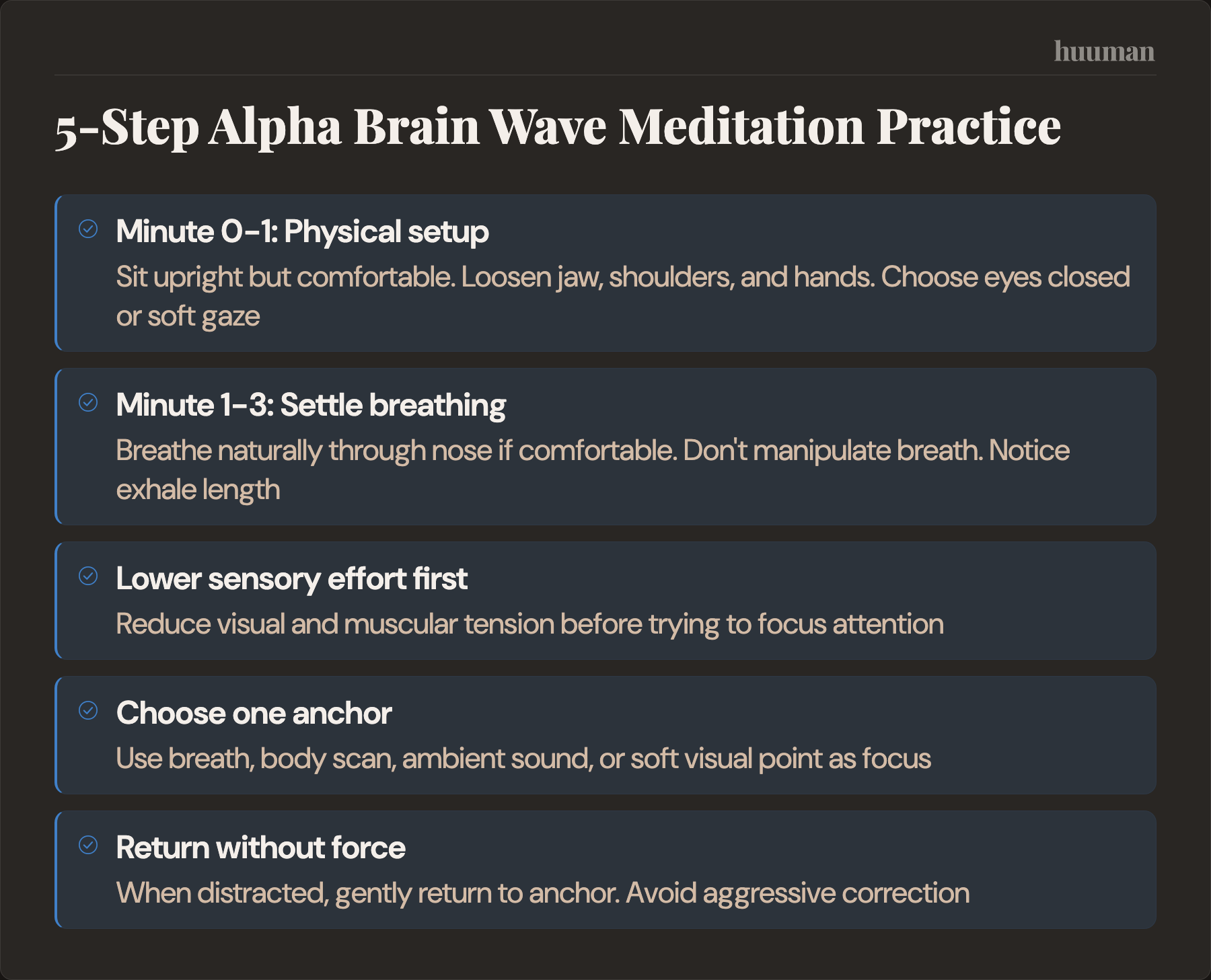
- Minute 0 to 1, cue: Sit upright but comfortable. Loosen jaw, shoulders, and hands. Decide whether eyes closed or soft gaze feels safer.
- Minute 1 to 3, settle: Breathe naturally through the nose if comfortable. Do not manipulate the breath much. Just notice exhale lengthen on its own.
- Minute 3 to 7, anchor: Choose one target: the breath at the nose, the rising and falling of the chest, body sensations from head to toe, ambient sound, or a visual point.
- Minute 7 to 9, let go: Each time you notice planning, evaluating, or drifting, label it lightly and return. No force.
- Minute 9 to 10, re-orient: Open the visual field, notice three sounds, and stand up slowly.
This sequence follows a simple logic: set the context, pick an anchor, let go of over-efforting, and measure what changed. That structure is more useful than hunting for a feeling called "alpha."
Minimal effective dose for busy professionals
If 10 minutes feels unrealistic, use 5 minutes daily for 7 days: 2 minutes of comfortable nasal breathing, 2 minutes of body scan, and 1 minute of re-orienting with eyes open while naming three sounds. On high-stress days, add a second 5-minute session instead of stretching one session into something longer and more effortful.
Choose the anchor by goal
- Calm and decompression: body scan or ambient sound.
- Focus before work: breath or a soft visual point.
- Sleep onset support: body scan or sound, with dim light and low cognitive effort.
- If closing eyes feels bad: keep eyes open and use soft focus.
If you already use tools like 4 7 8 breathing, treat them as adjacent options, not mandatory upgrades. Alpha-style meditation should feel easier, not more complicated.
Do binaural beats, isochronic tones, or "432 Hz" work?
This is where most online content becomes misleading. Entrainment refers to claims that external rhythmic stimulation can synchronize brain activity to a target frequency. That is biologically plausible in some contexts, but product claims often run well ahead of the evidence.
A meta-analysis of binaural beats found medium effect sizes for cognition, though studies remain scarce and controversial. They may influence some outcomes in some settings, but that is not the same as guaranteed alpha entrainment or consistent real-world benefits for every user. If you feel calmer with certain audio, that may reflect expectancy, conditioning, reduced external distraction, the relaxation response, or a true auditory effect. The mechanism is usually less important than the honesty of the claim.
What is not supported by good evidence is the language common in marketing: "100% pure alpha," instant transformation, damage repair, guaranteed anxiety cure, or a specific frequency such as 432 Hz being medically therapeutic. Frequency labels in music are not clinical prescriptions. They may shape preference and mood, but preference is not proof of neurophysiological precision.
Use audio conservatively if you like it:
- Keep volume low.
- Do not use it while driving or during tasks needing full attention.
- Stop if it triggers headaches, agitation, dizziness, or a strange sense of unreality.
- Avoid rhythmic light or strobe content if you have a seizure history or suspect sensitivity to visual stimulation.
If your interest is mostly about using sound to work better, it helps to think in terms of music for concentration rather than magical frequency claims. The question is whether the audio supports behavior, not whether it confers a special brain state by label alone.
Evidence and limits
The evidence on meditation and EEG is meaningful but mixed. Reviews of meditation neurophysiology consistently show that different practices can produce different oscillatory patterns, including changes in alpha and theta, but there is substantial heterogeneity by method, experience level, recording conditions, and comparison group mixed EEG effects across mindfulness studies. A broader review of meditation-related neural oscillations reaches a similar conclusion: style matters, context matters, and results are not uniform neural oscillations differ across practices.
Focused attention practices may show different alpha behavior depending on whether the task demands active monitoring, sustained effort, or a more settled phase of practice attention demands influence spectral patterns. That is why it is a mistake to treat "more alpha" as a universal marker of success.
EEG can show shifts in spectral power. It cannot by itself prove that a session improved health, reduced disease risk, or created a superior mental state. The practical value of alpha brain wave meditation is therefore judged mainly by outcomes you can observe in life: reduced perceived stress, smoother transitions into work or sleep, less mental urgency, and clearer attention when it matters.
There is also a useful link to drowsiness. Research on sleep onset found changes in subjective experience alongside alpha activity during the transition from wakefulness toward sleep alpha activity changes near sleep onset. That does not mean alpha equals sleep. It means state shifts are gradual, and the line between calm wakefulness and drowsiness is not sharp.
Evidence on subjective stress reduction from meditation is generally stronger than evidence that any particular EEG band is the key mechanism. If your sessions make you calmer and more functional, that is more relevant than trying to infer exact brain rhythms from a sensation.
Non-prescriptive strategies to discuss with a professional

Strategy A: the no-audio alpha session
This is the default option because it removes marketing noise. Sit comfortably, decrease visual and muscular effort, and stay with one anchor for 5 to 10 minutes. Common mistakes are over-breathing, correcting posture too aggressively, and trying to suppress thoughts. The better correction is to simplify the task.
Strategy B: eyes-open soft focus for anxious beginners
Some people feel worse when they close their eyes. That can include an anxiety spike, agitation, or a sense of losing orientation. An eyes-open version is often more tolerable: look at a neutral spot several feet away, soften the gaze, notice contact with the chair or floor, and let sounds remain in the background. For some people, this is the difference between a usable practice and one they avoid.
Strategy C: a pre-sleep downshift
If your goal is sleep onset, avoid treating alpha brain wave meditation as a sleep hack you must "win." Keep the session short, low-stakes, and dimly lit. The aim is reducing cognitive arousal, not manufacturing unconsciousness. If sound helps, keep it simple and compare it honestly with alternatives like silence, sleep music, or a brief body scan.
Personalization rules
- If you get sleepy, sit up taller, keep eyes open, and shorten the practice.
- If you get agitated, widen attention to sounds and body contact points.
- If you are already calm, add gentle counting to the breath for light structure.
- If you train hard, use it after sessions or in the evening as recovery support, not as another performance task. Athletes focused on consistency often benefit more from repeatable downshifts than from forcing intensity, much like the logic behind durable motivation for runners.
- If your practice starts to feel like another goal system, revisit your wider priorities such as ambition goals and whether this habit is supposed to calm you or become another metric to chase.
How to track and interpret changes
The best first-line tracking for alpha brain wave meditation is subjective, simple, and repeatable. Use two daily 0 to 10 ratings before practice and again 10 minutes after: perceived stress and mental clarity. Then track two sleep notes at night: estimated time to fall asleep and number of awakenings.
Use a 2 to 4 week window before changing the method. One good or bad session means very little. Trends matter.
One-screen CALM Loop checklist
- Cue: same chair, same timer, same low-friction setup.
- Anchor: choose one target only: breath, body, sound, or visual point.
- Let-go: notice drift, release effort, return once.
- Measure: record stress and clarity before and after.
14-day Alpha Downshift tracker example
- Day 1, 1:15 pm: 5 minutes, body scan, stress 7 to 5, clarity 4 to 6, easier return to work, no audio.
- Day 3, 10:40 pm: 8 minutes, sound anchor, stress 6 to 4, clarity 3 to 4, sleep onset felt shorter, 1 awakening.
- Day 6, 5:50 pm: 5 minutes, soft gaze and breath, stress 8 to 6, clarity unchanged, had caffeine late, mind very busy.
- Day 10, 9:30 pm: 10 minutes, body scan, stress 5 to 3, clarity 5 to 5, less urge to scroll, fell asleep more easily.
Optional wearable data can add context, but keep expectations realistic. Factors like illness, alcohol, poor sleep, travel, menstrual cycle, and training load may influence resting heart rate and HRV trends. They are not direct measures of alpha. If they move in a favorable direction alongside better subjective outcomes, that may be useful. If they do not, do not assume the practice failed.
That conservative mindset applies to consumer devices broadly. A wearable estimate is not laboratory EEG. If you also care about broader attentional skills, compare what you notice here with approaches covered in focus in you explained and all about focus on what you can control.
If you want a clearer picture than scattered notes can provide, your huuman Coach can interpret stress sleep and session trends over time so you can see whether this practice is helping calm, focus, or recovery instead of relying on one-off impressions.
Signal vs noise
- "Alpha waves heal damage." That is marketing language, not a credible medical claim. Treat it as a red flag and return to measurable outcomes like mood, focus, and sleep.
- "432 Hz is therapeutic." Preference and pleasantness are real, but a tuning label is not a clinical intervention. If you like a track, compare it with silence for a week before crediting the frequency.
- "If I am thinking, I am not in alpha." Thoughts do not disqualify the practice. Watch whether urgency drops and returning becomes easier.
- "More effort will get me there faster." For many people, over-efforting raises arousal. Loosen the task and shorten the session tomorrow.
- "Binaural beats guarantee alpha." Evidence is mixed and individual response varies. Use audio only if it reliably improves your experience.
- "Wearable calm scores prove brain state." Consumer metrics can be useful context, but they are indirect and noisy. Check for consistency across several days rather than trusting one reading.
- "Sleepiness means success." Sometimes it just means you crossed from relaxed alertness toward drowsiness. If your goal is focus, try an earlier session with eyes open.
- "Eyes closed is always better." Not if it increases anxiety or dissociation. Switch to soft focus and grounding immediately.
- "If one session felt amazing, I found the answer." The real test is repeatability. Keep the same method for 2 weeks before drawing conclusions.
- "Any alpha audio is safe." Stop if you get headaches, agitation, dizziness, panic, or a detached feeling, and avoid visual strobe content if seizure risk is a concern.
Common questions
What is alpha wave meditation?
Alpha wave meditation is a plain-language term for meditation intended to cultivate relaxed wakefulness. It refers to a state commonly associated with alpha oscillations on EEG, not to a guaranteed electrical reading you can feel directly.
How do you activate alpha brain waves?
A better question is how to create conditions associated with alpha-style calm. Reduce sensory input, relax unnecessary muscle tension, choose one easy anchor, and return without force. For most people, that works better than searching for a special soundtrack.
Do alpha brain waves actually work?
Alpha brain waves themselves are not a product that "works." They are a pattern associated with certain states. What may help is the practice that promotes calmer, less effortful attention. Judge it by outcomes you notice in life, not by promises attached to a frequency label.
Is alpha better than theta for meditation?
Not categorically. Alpha is often a useful practical target when you want calm alertness. Theta may become more relevant as you get drowsy or enter other meditative states. There is no single best brainwave for everyone or every goal.
Can binaural beats put your brain into alpha?
According to research on binaural beats and cognition, they may influence some people in some contexts, but studies remain scarce and controversial. They are not reliable enough to treat them as a guaranteed route into alpha. If they help you settle, fine. If not, you are not missing the essence of the practice.
What are the benefits of 432 Hz alpha waves?
There is no strong basis for treating 432 Hz as a proven therapeutic frequency. People may prefer how certain music feels, and that preference can matter for relaxation, but that is different from showing a specific medical or neurophysiological advantage.
Can alpha meditation help sleep?
It may help some people fall asleep more easily by reducing mental activation before bed. The useful test is whether your sleep onset feels smoother across a couple of weeks, not whether you can confirm a brainwave state. If sleep is your main issue, it also helps to look at contributing factors rather than relying on one tool, including topics like understanding deep sleep pillow spray with the same skeptical filter.
Is it safe for anxiety or trauma history?
Sometimes, but not always. Meditation can also increase discomfort in some people, especially if eyes closed stillness evokes panic, dissociation, depersonalization, or traumatic material. Use shorter sessions, eyes-open versions, and stop if symptoms escalate. Seek professional support if practice triggers panic attacks, flashbacks, severe distress, new headaches, hearing problems with audio, suicidal thoughts, or concern about seizure sensitivity.
More health topics to explore
- Mindset, Stress & Mental Health – Overview
- Music for Focus: Which Sounds Actually Help—and When They Get in the Way
- How to Improve Concentration: What Helps Right Away
- How to Focus on Yourself: Without Feeling Selfish
References
- Diaz BA et al. — Resting-State Subjective Experience and EEG Biomarkers Are Associated with Sl... (2016)
- Lomas T et al. — A systematic review of the neurophysiology of mindfulness on EEG oscillations (2015)
- Lieberman JM et al. — Neurophysiological mechanisms of focused attention meditation: A scoping syst... (2025)
- Healthline — Alpha Brain Waves
- Lee DJ et al. — Review of the Neural Oscillations Underlying Meditation (2018)
- Garcia-Argibay M et al. — Efficacy of binaural auditory beats in cognition, anxiety, and pain perceptio... (2019)