

Zone 2 vs. Zone 3 training is often explained as if it were only about two numbers on your watch. In practice, the difference matters more than that: Zone 2 is the intensity that lets you accumulate a lot of aerobic volume. Zone 3 is noticeably more demanding, can be performance-relevant, and usually comes with a higher recovery cost.
Key takeaways
1. Zone 2: easy to controlled, full sentences are possible, RPE usually light to moderate, a good choice for volume.
2. Zone 3: clearly more demanding, talking becomes shorter, RPE moderate to hard, a good choice for targeted tempo work.
3. Decision: use plenty of Zone 2 for the base, add Zone 3 in measured doses for specific adaptations, not on autopilot.
The confusion comes from the fact that wearables, coaching apps, and training books do not always use the same zone model. Depending on the system, Zone 3 may still be moderate, or it may sit close to a threshold. Once you know which model you are using, it becomes much easier to decide whether a session was truly easy, moderate, or specifically hard.
This guide explains how Zone 2 and Zone 3 feel, which markers work in real life, when Zone 3 can be useful, and how to avoid turning every workout into an unplanned medium-hard grind.
Where Zone 2 and Zone 3 Fit in Endurance, Metabolism, and Recovery
Endurance training is not just heart rate training. It is an interaction between oxygen uptake, muscular efficiency, lactate production, lactate clearance, breathing, and recovery cost. For a broader introduction to cardiovascular performance, see this overview of overview of heart and endurance training.
Zone 2 usually sits below the first ventilatory threshold, often called VT1. At this intensity, aerobic energy production dominates, breathing stays controlled, and lactate can generally be used and cleared well. Zone 3 sits higher. Depending on the system, it can range from moderately hard to close to threshold pace, with more breathing drive and a greater need for recovery.
Research supports using these breathing-based markers: a meta-analysis found that ventilatory thresholds align closely with lactate thresholds, which helps confirm VT1 and VT2 as boundaries between intensity zones.
For longevity, everyday resilience, and repeatable performance, the key question is not which zone is “better.” The better question is: which intensity serves the purpose of today’s session without unnecessarily compromising the next ones?
Quick Answer
If your goal is aerobic base, metabolic efficiency, durability, and long-term training consistency, Zone 2 will usually do most of the work. If your goal is pace, race-adjacent sustained effort, or controlled work near threshold, Zone 3 can be useful when planned deliberately. Zone 3 becomes a problem mainly when it turns into your default intensity and every session becomes “a little bit hard.”
- Zone 2: easy to controlled, full sentences are possible, RPE usually light to moderate, a good choice for volume.
- Zone 3: clearly more demanding, talking becomes shorter, RPE moderate to hard, a good choice for targeted tempo work.
- Decision: use plenty of Zone 2 for the base, add Zone 3 in measured doses for specific adaptations, not on autopilot.
If you want to calibrate your zones more clearly, you can log your endurance check-ins and sessions in the huuman app and review RPE, heart rate, and recovery.
First, Clarify Which Zone Model You Mean
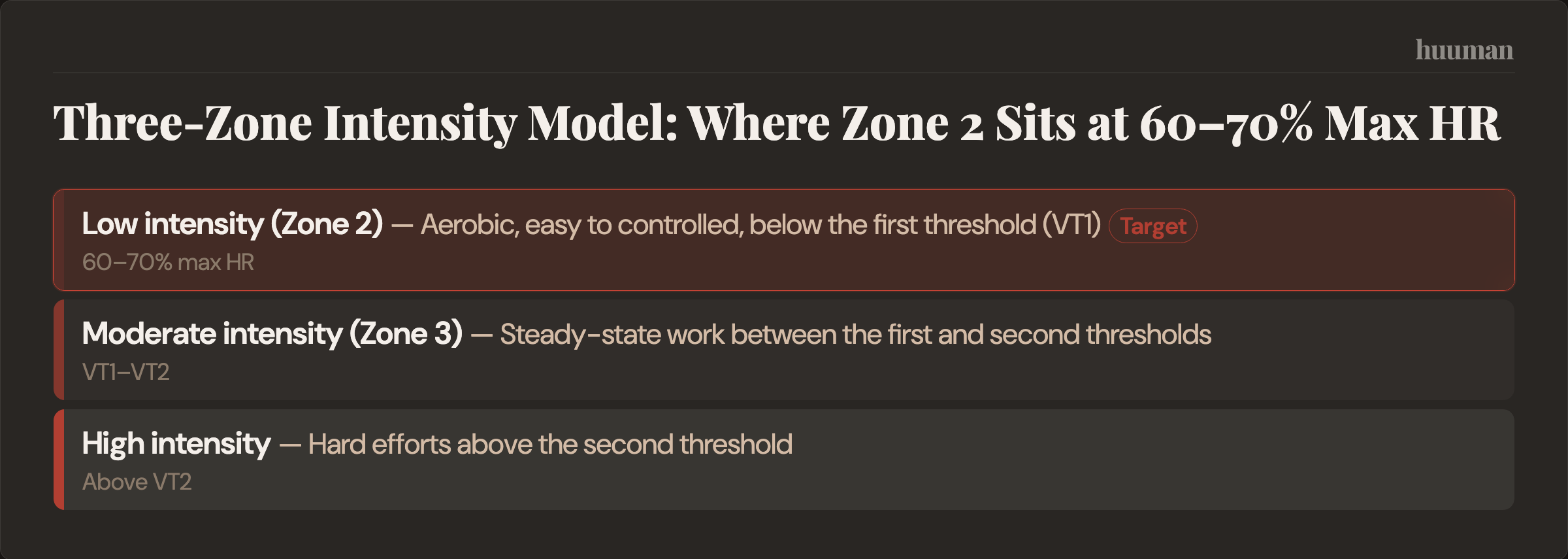
In a three-zone model, training is often divided into low, moderate, and high intensity. The boundaries are generally based on the first and second thresholds. A five-zone model splits those areas into smaller bands. That means “Zone 3” in one source may not mean the same thing as “Zone 3” on your watch.
Many wearables use percentages of maximum heart rate or heart rate reserve based on the Karvonen method. That can be practical, but it is also error-prone if your estimated max heart rate is wrong or if your individual thresholds sit somewhere different. Power in watts, pace, lactate readings in mmol/L, and breathing markers can add useful context, but they are also situation-dependent.
In practice, clinical guidance commonly places Zone 2 at around 60–70% of maximum heart rate, though individual thresholds can sit somewhat higher.
Mini glossary: VT1, or the first threshold, describes the transition from very easy to moderate. VT2, or the second threshold, describes the transition from moderate to hard. The closer you get to VT2, the more recovery matters, and the less that session should happen by accident.
Zone 2 vs. Zone 3: How They Compare
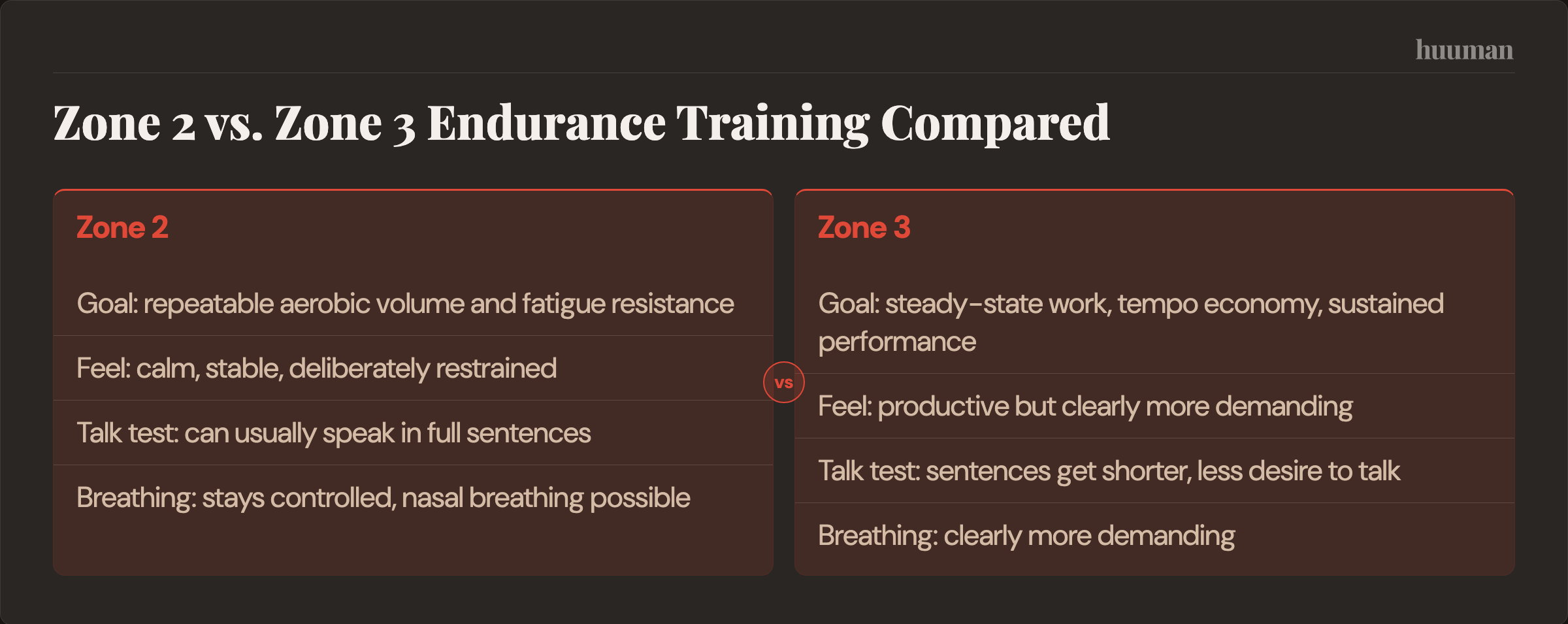
- Goal: Zone 2 primarily builds repeatable aerobic volume and fatigue resistance. Zone 3 is more about steady-state work, tempo economy, and controlled sustained performance.
- Feel: Zone 2 feels calm, stable, and deliberately restrained. Zone 3 feels productive, but clearly more demanding.
- Talk test: In Zone 2, you can usually speak in full sentences. In Zone 3, sentences get shorter and you no longer want to talk for long.
- Breathing: In Zone 2, breathing stays controlled. Nasal breathing can be a clue, but it is not a strict rule. In Zone 3, breathing becomes more active.
- Recovery cost: Zone 2 usually has a better “return on recovery.” Zone 3 accumulates fatigue more quickly, especially during stressful periods, poor sleep, or high weekly training load.
- Use in a plan: Zone 2 fits base runs, easy rides, and build phases. Zone 3 is better suited to deliberately planned tempo sessions, marathon or half-marathon-adjacent work, and cycling efforts specific to longer time trials.
How to Recognize Zone 2 and Zone 3 Without a Lab
The talk test is often more reliable than the supposedly precise number on your watch. If you can speak comfortably in full sentences and feel like you could hold the intensity for a long time, you are probably in the lower aerobic range. If you can only speak in short phrases, your breathing is clearly audible, and you need to focus mentally on maintaining the pace, you are more likely in Zone 3 or above.
RPE gives you a second self-check without needing to turn it into a rigid science. On a 0-to-10 scale, Zone 2 often feels “light to controlled,” while Zone 3 feels “noticeably demanding, but not maximal.” The exact number matters less than whether RPE, breathing, the talk test, and heart rate all tell a consistent story.
Heart rate lags behind effort. During short segments, pace or watts are often more stable guides than pulse. During longer sessions, cardiovascular drift can occur: heart rate rises at the same pace or power, especially in heat, dehydration, after caffeine, at altitude, under stress, or after a poor night’s sleep.
What Zone 2 Trains
Zone 2 is useful because it allows a lot of training time at a relatively low cost. You train aerobic energy production, movement economy, and the ability to repeat controlled efforts. That is why Zone 2 is attractive for runners, cyclists, swimmers, and busy everyday athletes.
Evidence also suggests that submaximal aerobic intensities are where whole-body fat oxidation tends to peak, which helps explain why Zone 2 is associated with metabolic efficiency.
The most common Zone 2 mistake is starting too hard. The first 15 minutes feel easy, heart rate rises later, and by the end the workout was closer to Zone 3. This is especially noticeable in cycling because watts and heart rate are easy to compare. If you want to go deeper, this guide to Zone 2 cycling is useful. For indoor setups, see also Zwift Zone 2 training.
What Zone 3 Trains
Zone 3 is not pointless. It can be relevant for steady-state work, tempo durability, and race-specific demands. In running, that may feel close to controlled marathon or half-marathon effort. In cycling, it may resemble longer, steady time-trial-style work.
The tradeoff is that Zone 3 often costs more than it feels like it should. It does not feel like a true interval session, but it is not easy either. If it appears too often, there is little room left for genuinely low-intensity volume and not much freshness for truly hard work such as intervals, VO2max-focused sessions, or short high-intensity formats. Those stimuli are usually better handled with separate structures, such as a detailed HIIT workout plan, a Tabata high-intensity workout guide, or, for swimming specifically, a VO2max swim protocol.
Understanding the “Gray Zone”
“Gray zone” does not mean Zone 3 is bad. It refers to a training pattern in which too many sessions become medium-hard: not easy enough for high volume, not specific enough for a clear hard stimulus. This can show up as persistently high RPE at the same pace, lower motivation to train, poorer sleep quality, or a noticeably higher resting heart rate. These are signals, not diagnoses.
Polarized training and pyramidal training are often discussed as models in training literature. The well-known 80/20 heuristic is commonly used, but it should not be treated as a universal law. For many people, the practical version is simpler: several low-stress sessions around one deliberately planned moderate or hard session, adjusted for recovery, life demands, and goals.
Decision Tree: Which Intensity Fits Today?
- Is your main goal base fitness, health, returning to training, or stress tolerance? Choose mostly Zone 2 and keep the session lighter than your ego wants.
- Are you training for speed, a half marathon, a marathon, a time trial, or longer steady-state performance? Use Zone 3 deliberately as a tempo session, not as every second “easy” workout.
- Did you sleep poorly, have heavy legs, notice an unusually high resting heart rate, or see a declining HRV trend? Consider replacing Zone 3 with easy training or rest.
- Do you have very little time? Combine short Zone 2 sessions with one clearly structured tempo session instead of making every workout medium-hard.
- Does your heart rate drift sharply upward at the same pace? Start the next Zone 2 session more conservatively and recheck the talk test and RPE at the end.
Example Weeks, Not Prescriptions
These examples are training structures, not personal instructions. They show how Zone 2 and Zone 3 can appear in a week without defining specific intensities medically or individually.
- Minimal: Two easy Zone 2 sessions, such as cycling, treadmill work, or jogging, plus one controlled Zone 3 tempo session if sleep and legs are in a good place. A 45-minute treadmill workout can provide a structured format.
- Standard: Several Zone 2 sessions, one planned Zone 3 session, and one rest day or very easy day. The goal is to clearly separate true ease from targeted stimulus.
- Advanced: More Zone 2 volume, one targeted Zone 3 session, and occasional harder work only if recovery, motivation, and performance data remain stable. After long races, this structure needs adjustment, similar to marathon recovery.
- Across sports: An easy swim, a Zone 2 ride, a relaxed run, and a tempo session can serve the same purpose if RPE, breathing, and recovery stay consistent.
Protocol Cards for Practical Use

Zone 2 Base Run or Base Ride
- Structure: Start very easy, then stay steady in the presumed Zone 2 range, and finish with an easy cooldown.
- Intensity: Talk test with full sentences, RPE light to controlled, pace or watts stable.
- Readiness gates: HRV trend not clearly declining, resting heart rate not unusually elevated, no heavy muscle soreness, no acute sleep debt.
Controlled Zone 3 Tempo
- Structure: Warm up easily, then complete longer controlled tempo segments with very easy recovery between them, followed by an easy finish.
- Intensity: Noticeably demanding, but not all-out. Short sentences are possible, RPE is moderate to hard, and breathing is clearly more active.
- Important: During short intervals, heart rate lags. In those cases, rely more on RPE, pace, or power than on pulse.
Drift Check for Zone 2 Calibration
- How to do it: After an easy start, hold a steady pace or power in your presumed Zone 2 range.
- What to observe: Compare heart rate, RPE, and the talk test between the beginning and end of the steady portion.
- Example interpretation: You start with controlled breathing and full sentences, but finish with much shorter sentences and higher RPE. That suggests the intensity was probably too high for true Zone 2.
Mini checklist: Am I really in Zone 2? Full sentences are possible, shoulders stay relaxed, pace feels controlled, there is no mental battle, and breathing remains steady. Am I accidentally in Zone 3? You are waiting for the session to end, barely talking, heart rate is drifting, and “easy” feels like work.
Evidence and Limits
Research on training intensity distribution suggests that the right mix of low, moderate, and high intensity depends on the goal. There is no single zone formula that works equally well for every sport, performance level, and life situation. Without specific external sources for this article, it is best to treat percentage targets, rigid weekly frequencies, and superiority claims with caution.
The biggest limitations are in field testing itself. Max heart rate estimates can be wrong, optical wrist-based heart rate is more vulnerable to movement error than a well-fitted chest strap, and pace is not directly comparable across wind, incline, or trail conditions. Lactate testing can be useful, but it requires clean execution and interpretation.
Context also changes the zone. Heat, dehydration, altitude, caffeine, infections, the menstrual cycle, sleep deprivation, and psychological stress can shift heart rate at the same output. That is why a single data point rarely tells the full story. Patterns across multiple sessions are much more valuable.
Strategies to Discuss With a Professional
Base block: If you are returning to training, under heavy work stress, sleeping poorly, or building back up, a Zone 2-dominant block may be useful. The principle is simple: stabilize repeatable volume first, then raise intensity.
Performance mix: If you want to improve pace, one targeted Zone 3 session per training week can be a conservative entry point into structured tempo work. This is not a rule, but an example of how many programs dose moderate stimuli.
Limited time: If time is short, clear separation often works best: short easy sessions for aerobic consistency, one structured tempo session for the specific stimulus, plus everyday movement. For body composition, training is only one part of the picture, as this article on fat loss in women explains. Very short formats such as the one-and-done workout serve a different purpose and should not be confused with Zone 2 base.
Recovery and metabolic context: Extreme nutrition or fasting protocols can change how training feels, energy availability, and recovery. If you are interested in that topic, this 84-hour fasting guide puts that kind of stressor into a broader context. An intermittent hypoxia protocol is also a separate stimulus, not a replacement for well-managed endurance zones.
How to Measure and Interpret Progress
Good training control starts with a few stable signals. Watch whether you can produce slightly better pace or power at the same heart rate, whether RPE drops for the same session, and whether heart rate drifts less at a constant output. These are not guarantees, but they are useful signs of improving aerobic control.
A drift check every few weeks can help you test your Zone 2 assumption. Consistency matters: use a similar route or indoor setup, comparable sleep, similar temperature, and no unusual fatigue going in. HRV is a decision-support tool, not an oracle. One low reading matters less than a trend viewed alongside resting heart rate, sleep, and subjective fatigue.
If you want to turn these signals into concrete weekly decisions, your huuman Coach can adapt your weekly plan to recovery and training load instead of assigning Zone 2 and Zone 3 rigidly by calendar.
Signal and Noise in Zone 2 vs. Zone 3 Training
- “Zone 3 is forbidden” is noise. Instead, ask whether Zone 3 has a clear purpose in your week.
- “Zone 3 becomes the gray zone when it becomes your default” is signal. After every session, mark whether it was truly easy, moderate, or hard.
- The percentage zones on your watch are only a starting point. Calibrate them with the talk test, RPE, and drift instead of trusting them blindly.
- Nasal breathing is not a law. Use it as a clue, but decide based on breathing, sentence length, and overall feel.
- Heat and stress shift heart rate. Do not compare those sessions directly with cool, well-rested days.
- Pace can guide short segments better than pulse. Use heart rate more for post-session analysis in those cases.
- Moderate fatigue after every workout is not a sign of quality. Build in real ease before adding more intensity.
- Declining motivation can be a load signal. Look at sleep, resting heart rate, and weekly volume before forcing the next tempo session.
Common questions
Is Zone 3 training really the gray zone?
Zone 3 is only a gray zone when it dominates unintentionally. As a targeted tempo session, it can be useful. As your daily default intensity, it can blur the line between easy volume and specifically hard training.
How can I recognize Zone 2 without a heart rate monitor?
Use the talk test, RPE, and breathing. You should be able to speak in full sentences, breathing should stay controlled, and the session should not feel like a fight. If you are speaking much more effortfully at the end than at the beginning, you were probably too high.
Why is my heart rate so high in Zone 2 even though it feels easy?
Possible reasons include heat, dehydration, caffeine, poor sleep, stress, altitude, an inaccurate sensor, or an incorrectly estimated max heart rate. If feel and heart rate do not line up, compare several sessions under the most stable conditions you can.
Can Zone 3 running improve my race pace?
Zone 3 can support race-specific sustained performance, especially if your goal involves longer steady efforts. But it does not replace the aerobic base and should not crowd out every easy run.
Zone 2 or Zone 3 for weight loss: which is better?
Body weight depends on the whole lifestyle, not one training zone. Zone 2 is often easier to repeat consistently, while Zone 3 creates more acute load. What matters most is consistency, recovery, nutrition, and a plan that does not collapse after two weeks.
How often should I do Zone 3 if I can only train three times per week?
Many programs would use one clear tempo session and keep the other sessions easy, assuming recovery is good. If sleep, resting heart rate, or your legs are not in a good place, it is often smarter to delay the moderate session.
What is the difference between Zone 3 and sweet spot in cycling?
Sweet spot in cycling is usually defined by power and oriented around threshold. Zone 3 can sit below or near that range depending on the model. First clarify whether you are talking about heart rate zones, wattage ranges, or threshold percentages.
If it is hard to reconcile your goals, recovery, and available time, your huuman Coach can help place intensities into your weekly plan so Zone 2, Zone 3, and harder stimuli do not work against each other.
The best practical starting point is not perfection. It is clean separation: easy truly easy, tempo deliberately planned, and hard work clearly justified. That turns Zone 2 vs. Zone 3 training from a debate about numbers into a better decision for your week.
More health topics to explore
- Heart & Cardio – Overview
- Human Walking Speed: Averages, Tables, and a Simple Self-Test
- Zone 2 Pace Calculator
- Intermittent Hypoxia: Benefits, Risks, and a Conservative Protocol
References
- Cleveland Clinic — What Are the Five Heart Rate Zones?
- Casado A et al. — Training Periodization, Methods, Intensity Distribution, and Volume in Highly... (2022)
- Mølmen KS et al. — Effects of Exercise Training on Mitochondrial and Capillary Growth in Human... (2025)
- Tanner V et al. — Agreement Between Heart Rate Variability - Derived vs. Ventilatory and... (2024)
- Ruiz-Moreno C et al. — Caffeine increases whole-body fat oxidation during 1 h of cycling at Fatmax (2021)
- Cleveland Clinic — Heart Rate Reserve: How to Calculate It & What It Means
- Jeukendrup et al. — Heart rate monitoring during training and competition in cyclists. (1998)
- Ross et al. — Importance of Assessing Cardiorespiratory Fitness in Clinical Practice: A Case for Fitness as a Clinical Vital Sign: A Scientific Statement From the American Heart Association. (2016)
About this article · Written by the huuman Team. Our content is based on peer-reviewed research and clinical guidelines. We follow editorial standards grounded in scientific evidence.
This article is for educational purposes only and does not constitute medical advice. Health and training decisions should be discussed with qualified professionals.

