Most people measure their health by a single number: weight, steps, BMI, maybe resting heart rate. And most of the time, that number tells them almost nothing about whether they're actually healthy.
A person at their "ideal weight" can have dangerously low cardiovascular fitness, pre-diabetic fasting glucose, chronic sleep deprivation, and accelerating muscle loss. None of that shows up on a bathroom scale. None of it shows up in the standard annual checkup.
Health operates across five interconnected areas. Understanding them is the difference between tracking noise and tracking signal.
Heart: cardiovascular fitness
Your cardiovascular system determines how efficiently your body delivers oxygen to every organ and tissue. The primary metric here is VO2max, your maximal oxygen uptake. Analysis of 122,007 patients found that low cardiorespiratory fitness carried a higher mortality risk than smoking, diabetes, or coronary artery disease, with no upper limit of benefit.

What to track: VO2max (via wearable or lab test), resting heart rate trends, heart rate variability (HRV) as a 7-day average, and blood pressure. Watch for gradual improvements in VO2max, declining resting heart rate, and stable or improving HRV patterns over weeks and months.
Clinical guidelines increasingly recognize VO2max as a vital sign for mortality prediction, supporting its routine assessment alongside traditional metrics.
What "good" looks like: VO2max targets vary by age and sex. Many fitness professionals consider values above certain thresholds as indicators of fitness level. Resting heart rate patterns can vary widely between individuals. HRV is highly individual, so track your own trend rather than comparing to population averages.
Highest-leverage action: Zone 2 aerobic training, 3-4 times per week, 30-60 minutes per session. This is the single most impactful habit for cardiovascular health at any age.
Evidence suggests that high-intensity interval training improves cardiorespiratory function in coronary artery disease patients, offering an alternative approach for those who may benefit from shorter, more intense sessions.
Frame: structural integrity
Your frame is the physical structure that lets you move through the world: muscle mass, bone density, joint health, mobility, balance, and functional strength. The landmark global study tracked nearly 140,000 adults across 17 countries and found that grip strength was inversely associated with all-cause mortality. Each 5 kg decrease in grip strength was associated with a 17% increase in cardiovascular mortality. Muscle mass tends to decline with age, particularly without resistance training. This process, called sarcopenia, accelerates after 60 and drives downstream effects across metabolic health (muscle is the body's largest glucose sink), bone density, fall risk, and independence. What to track: Grip strength (handheld dynamometer), body composition via DEXA scan (annually), functional movement quality, and training volume/progression. What "good" looks like: Grip strength benchmarks vary by population and measurement protocol. Lean mass within the healthy range for your age and sex. Highest-leverage action: Resistance training 2–3 times per week focusing on compound movements: squat, hinge, push, pull, carry. Progressive overload over months and years.
Evidence shows muscle strength predicts mortality in older adults, reinforcing why maintaining physical capacity matters beyond appearance.
Metabolism: the invisible engine
Metabolic health determines how efficiently your body regulates blood sugar, manages lipids, and controls inflammation. It's the area most likely to deteriorate silently for years before any symptom appears. Research published in Metabolomics found that only about 12% of American adults are metabolically healthy by comprehensive criteria: optimal blood glucose, triglycerides, HDL cholesterol, blood pressure, and waist circumference without medication. Many adults have at least one metabolic risk factor. The insidious part: your fasting glucose can drift from 85 to 99 mg/dL over a decade, technically "normal" the entire time, while insulin resistance progressively worsens. By the time a diagnosis arrives, the dysfunction has been building for years. What to track: Fasting insulin (more informative than glucose alone), HbA1c, triglyceride-to-HDL ratio, hs-CRP for inflammation, waist circumference. Consider a continuous glucose monitor for 2–4 weeks to understand your personal glycemic response to food. What "good" looks like: Optimal metabolic markers vary by individual and testing methodology. Work with your healthcare provider to establish appropriate targets. Highest-leverage action: Regular physical activity (both aerobic and resistance training), adequate protein intake, minimizing ultra-processed food, and maintaining consistent meal timing. These four habits address the majority of modifiable metabolic risk.

Recovery: the multiplier
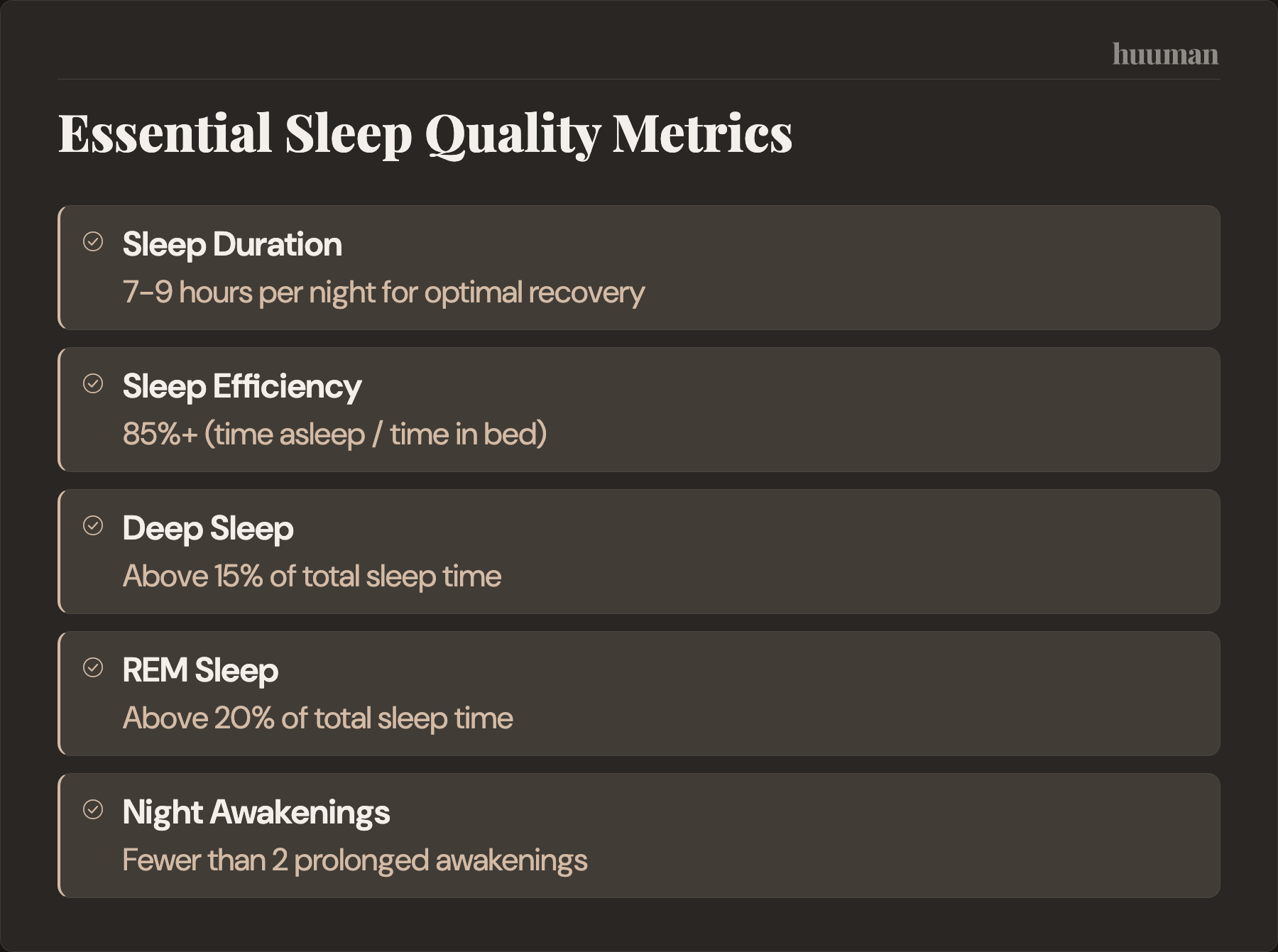
Sleep and recovery aren't passive downtime. They're the foundation every other area depends on. During deep sleep, your brain clears metabolic waste through the glymphatic system, growth hormone drives tissue repair, and immune function consolidates. During REM sleep, emotional processing and memory consolidation occur. Recovery also encompasses stress management and parasympathetic activation: your body's ability to return to baseline after physical or psychological challenge. What to track: Sleep duration, sleep efficiency (time asleep / time in bed), deep sleep and REM percentages, HRV trend (7-day average, not single readings), resting heart rate trend. What "good" looks like: 7–9 hours of sleep is recommended for adults. Sleep efficiency and architecture vary by individual. Deep sleep above 15% of total sleep. REM above 20%. Fewer than 2 prolonged awakenings per night. Stable or improving HRV trend. Highest-leverage action: Consistent sleep-wake timing (same time every day, including weekends). Stabilizing your sleep schedule improves sleep quality more reliably than any supplement or gadget.
Mind: cognitive and emotional resilience
Cognitive function, emotional regulation, and stress resilience are measurable, trainable, and subject to decline without active maintenance. Various lifestyle factors may influence cognitive health, including physical activity, social engagement, and sleep quality. Cognitive decline is not purely genetic destiny. Psychological stress can affect multiple body systems and overall health. The mind area isn't soft. It's physiological. What to track: Subjective stress levels and mood patterns, sleep quality (directly affects cognition), social engagement frequency, novel learning activities. Formal cognitive testing annually if over 50. What "good" looks like: Consistent ability to focus for extended periods, emotional recovery from setbacks within hours (not days), regular engagement in novel learning or complex problem-solving, maintained social connections. Highest-leverage action: Physical exercise (particularly aerobic training) is the strongest evidence-backed intervention for cognitive health. It's more effective than any brain-training app. Combined with quality sleep and social engagement, it provides the strongest protection against age-related cognitive decline.
How the areas interact
The five areas aren't independent columns. They're a network where every node influences every other. Poor sleep (Recovery) suppresses HRV and cardiovascular adaptation (Heart). Low fitness (Heart) accelerates cognitive decline (Mind). Chronic stress (Mind) disrupts metabolic regulation (Metabolism) and impairs muscle recovery (Frame). Metabolic dysfunction (Metabolism) drives systemic inflammation that degrades every other area. Muscle loss (Frame) reduces the body's largest glucose sink, worsening metabolic health. This interconnection is why single-metric optimization fails and why a primespan approach requires seeing all five areas simultaneously. It is the founding idea behind how huuman thinks about health. An improvement in any one area tends to lift the others. A decline in one tends to drag the rest down.
Depression itself is associated with accelerated cognitive decline, with exercise showing protective effects against depressive symptoms.
Where to start
Begin with the two areas that create the strongest ripple effects across all five dimensions. Recovery first. Sleep is the foundation that multiplies everything else. Better sleep immediately enhances cardiovascular recovery, metabolic regulation, cognitive clarity, and tissue repair.
Heart second. Build your aerobic base with Zone 2 training: 30-60 minutes of steady cardio at conversational pace, 3-4 times weekly. This single practice improves metabolic flexibility, deepens sleep quality, sharpens cognitive function, and builds emotional resilience.
Once these anchors are established, layer in resistance training for Frame, dial in nutrition for Metabolism, and add cognitive challenges for Mind. The compounding effect accelerates progress. Small wins in one area naturally support the others, creating positive momentum that makes the entire system easier to maintain.
Common questions
What are the five areas of health?
Heart (cardiovascular fitness and resilience), Frame (strength, mobility, bone density, and body composition), Metabolism (blood sugar regulation, lipid management, and inflammation), Recovery (sleep quality, stress recovery, and regeneration), and Mind (cognitive function, emotional regulation, and stress resilience).
Which area should I prioritize first?
Recovery (specifically sleep) is the highest-leverage starting point for most people because it directly influences all four other areas. After sleep, cardiovascular fitness shows strong associations with all-cause mortality and has wide-ranging positive effects on metabolic, cognitive, and structural health.
Can improving one area help the others?
Yes. The areas are interconnected, so improving one tends to lift the rest. Better sleep enhances cardiovascular recovery, metabolic regulation, cognitive function, and muscle repair. Regular exercise improves heart health, builds structural strength, sharpens cognition, and deepens sleep. The compounding works in your favor.
How do I track all five areas?
Wearables (Oura, Whoop, Apple Watch, Garmin) cover daily cardiovascular and recovery metrics. Quarterly bloodwork captures metabolic markers. Annual DEXA scans track body composition and bone density. Grip strength testing and functional movement assessments cover Frame. Cognitive and emotional tracking can be as simple as journaling stress patterns and monitoring focus quality.
What's the minimum effective approach?
Consistent 7–8 hour sleep schedule, 30 minutes of daily walking, resistance training 2–3 times per week, adequate protein intake, and one weekly social engagement that involves genuine connection. These five habits collectively touch all five areas without requiring radical lifestyle changes. Health isn't a number on a scale. It's five interconnected areas that determine how well you live. Have your huuman Coach build personalized weekly plans that balance strength, cardio, and recovery based on how each area is actually performing, not just how you think it should be.
More health topics to explore
- What Your Annual Checkup Misses
- Introducing huuman: The Science of Living Better, Longer
- Healthspan vs. Lifespan: What Actually Matters
References
- Leong et al. — Prognostic Value of Grip Strength: Prospective Urban Rural Epidemiology Study (2015)
- Guasch-Ferré et al. — Metabolomics in Prediabetes and Diabetes (Metabolomics, 2018)
- Ross et al. — Cardiorespiratory Fitness as Clinical Vital Sign (2016)
- Bueno-Antequera J et al. — Exercise and Depressive Disorder (2020)
- Yang Y et al. — Effects of high-intensity interval training on cardiorespiratory function in ... (2025)
- Fried LP et al. — Frailty in older adults: evidence for a phenotype (2001)
- Li R et al. — Associations of Muscle Mass and Strength with All-Cause Mortality among US Ol... (2018)
- Welch AA et al. — The relationships between sarcopenic skeletal muscle loss during ageing and m... (2020)
- Qiu et al. — Is estimated cardiorespiratory fitness an effective predictor for cardiovascular and all-cause mortality? A meta-analysis. (2021)
- Kalkanis et al. — Sleep regularity as an important component of sleep hygiene: a systematic review. (2025)
- Hauglund NL & Nedergaard M — Is glymphatic clearance the secret to restorative sleep? (2025)
- Hirshkowitz M et al. — National Sleep Foundation's updated sleep duration recommendations: final report (2015)
About this article · Written by the huuman Team. Our content is based on peer-reviewed research and clinical guidelines. We follow editorial standards grounded in scientific evidence.
This article is for educational purposes only and does not constitute medical advice. Health and training decisions should be discussed with qualified professionals.